How I Would Implement AI (If I Were Starting Again)
Most companies are experimenting with AI. Very few are redesigning how their organizations actually operate. After years of building systems, automations, workflows, integrations, and AI infrastructure, one thing is clear: the companies that win won't just "use AI." They'll become AI-native.
AI is not just another software trend. It's a new operational layer for business itself, the same way the internet stopped being a brochure and became how orders, support, and finance actually ran. If I were implementing AI again from a clean sheet, I wouldn't start with a tool list. I'd start with an operating model.
That's the direction we're building toward at Expert AI Labs: an AI control plane that connects departments, runs workflows with policy guardrails, and compounds outcomes instead of piling up disconnected scripts. Below is the seven-part framework we published on Instagram, expanded here with the full carousel, slide by slide.
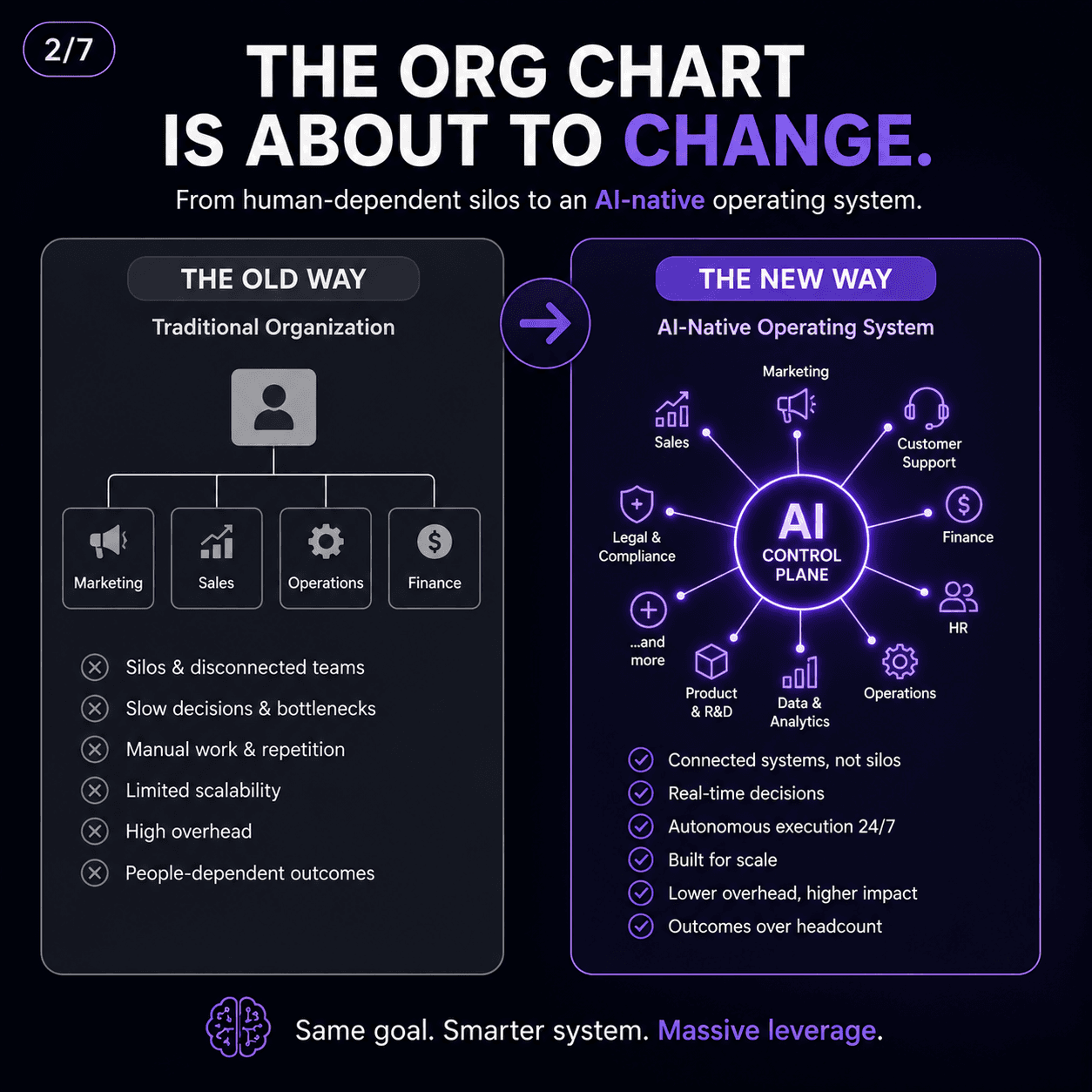
1. The org chart is about to change
The old model stacks Marketing, Sales, Operations, and Finance as separate towers, each with its own tools, its own spreadsheets, and its own bottlenecks. Decisions wait on handoffs. Scale means more people in each silo.
The new model puts an AI control plane at the center: one layer that connects systems, routes work, enforces policy, and executes 24/7 across every department. Marketing, Sales, Legal, Product, Data, HR, Finance, and Support all plug into the same operational nervous system. You get connected systems instead of silos, real-time decisions instead of queue-backed delays, and outcomes over headcount.
2. Start with outcomes, not tools
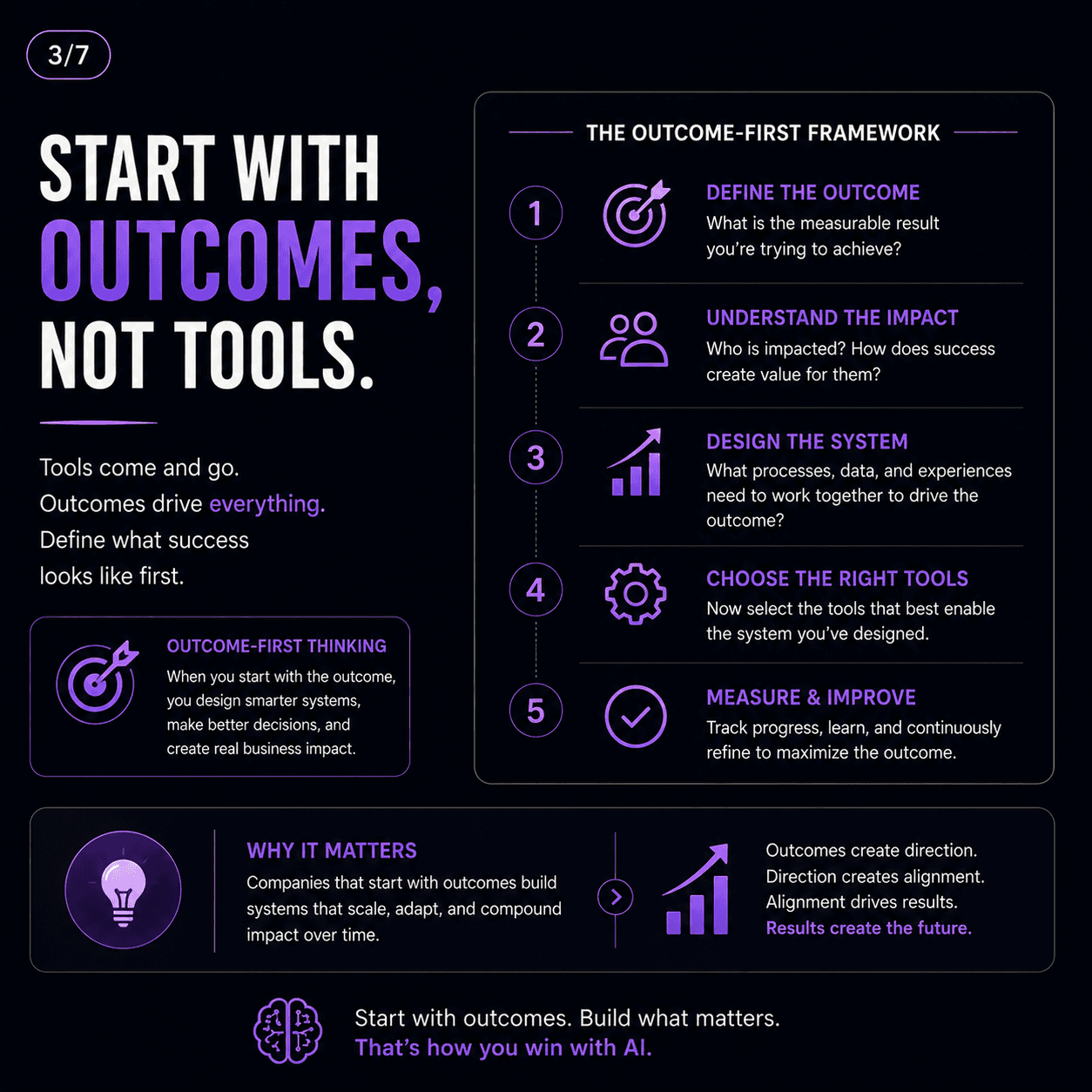
Tools come and go. Outcomes drive everything. When you start with the outcome, you design smarter systems, make better decisions, and create real business impact.
The sequence I use every time:
- Define the outcome, What measurable result are you trying to achieve? (Revenue, cycle time, error rate, capacity.)
- Understand the impact, Who benefits? What does success look like for them?
- Design the system, Which processes, data sources, and handoffs must work together?
- Choose the right tools, Only after the system is clear.
- Measure and improve, Track progress, learn fast, compound impact.
Companies that start with outcomes build systems that scale and adapt. Outcomes create direction; direction creates alignment; alignment drives results.
3. Remove bottlenecks, not just tasks
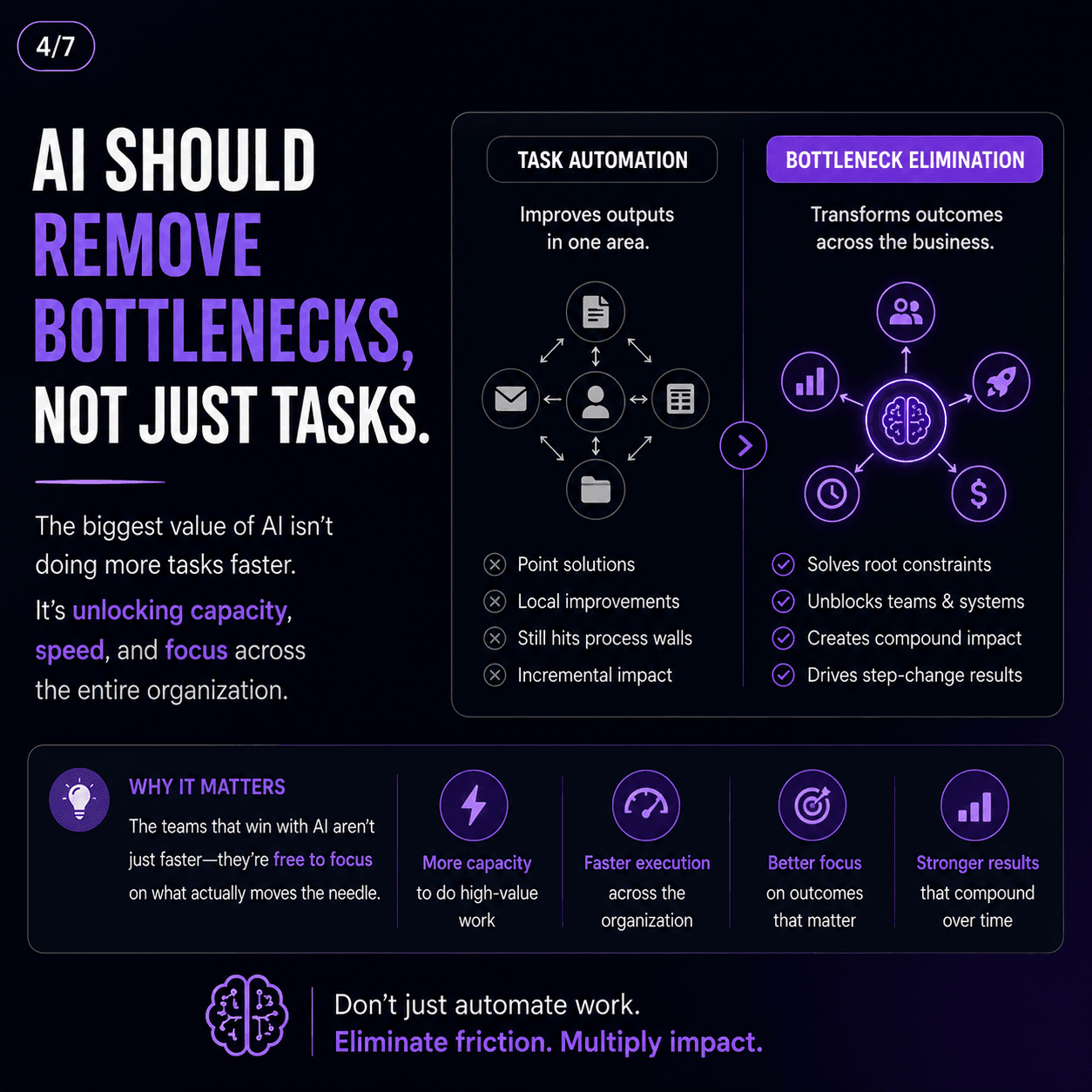
Task automation makes one person faster at email or data entry. That's useful, but it's incremental. The bigger value is bottleneck elimination: removing the constraints that block teams, systems, and revenue across the whole company.
Point solutions still hit process walls. Root-constraint work unblocks entire flows, lead intake, dispatch, billing, compliance, reporting, and creates compound impact. The teams that win with AI aren't just faster; they're free to focus on what actually moves the needle: capacity for high-value work, faster execution org-wide, better focus on outcomes, and results that stack quarter over quarter.
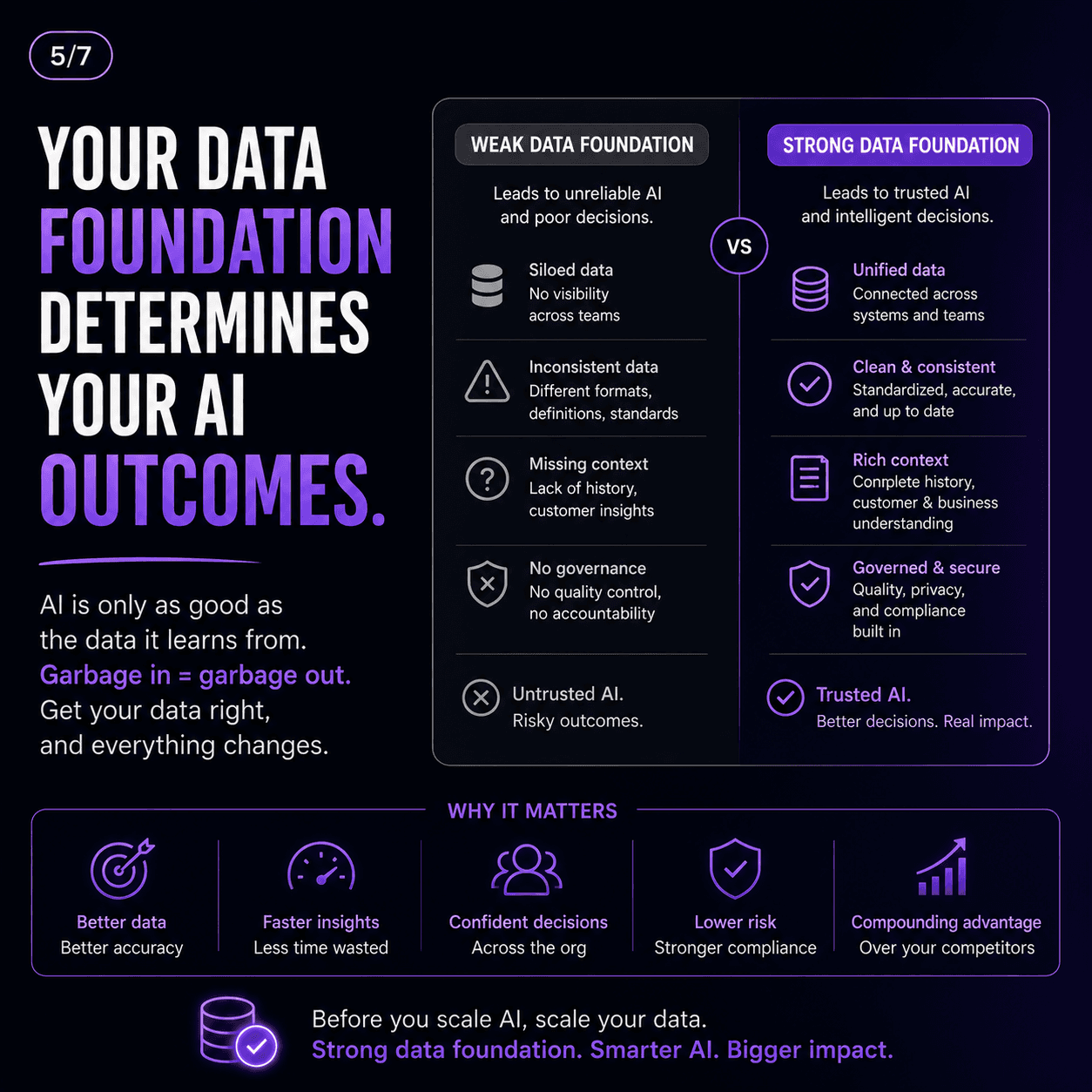
4. Your data foundation determines your AI outcomes
AI is only as good as the data it learns from. Garbage in, garbage out. A weak foundation (siloed data, inconsistent definitions, missing context, no governance) produces unreliable AI and risky decisions. A strong foundation (unified, clean, contextual, governed) produces trusted AI and intelligent action.
Before you scale AI, scale your data. Better data means better accuracy, faster insights, confident decisions across the org, lower compliance risk, and a compounding advantage over competitors still duct-taping spreadsheets.
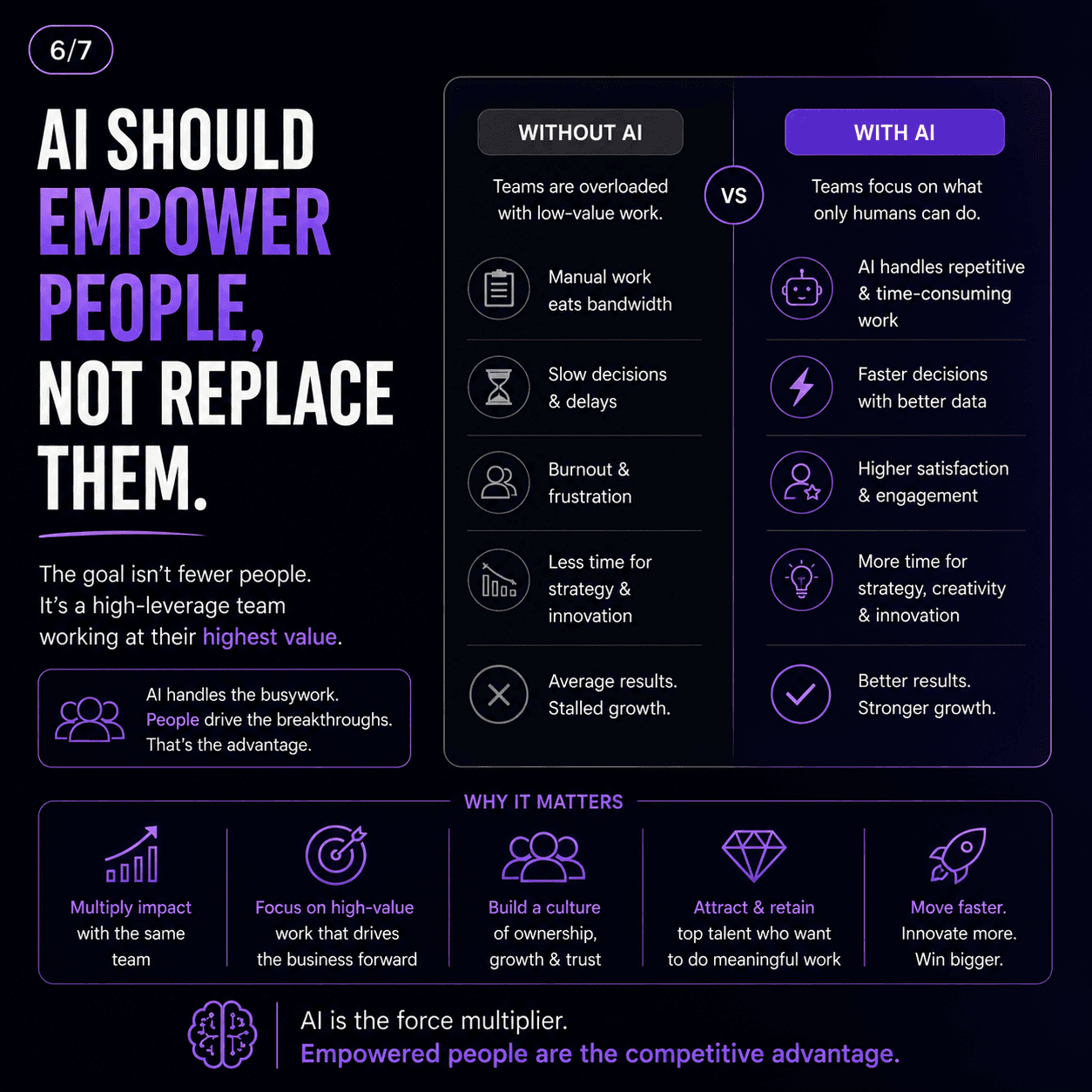
5. AI should empower people, not replace them
The goal isn't fewer people. It's a high-leverage team working at their highest value. AI handles the busywork; people drive the breakthroughs. That's the advantage.
Without AI, teams drown in manual work, slow decisions, burnout, and stalled growth. With AI done right, repetitive work shrinks, decisions speed up with better data, satisfaction rises, and strategy and innovation get the hours they deserve. AI is the force multiplier; empowered people are the competitive advantage.
6. Build systems, not disconnected automations
Most companies are adding AI. Few are redesigning how they operate. Disconnected automations, one Zap, one chatbot, one copilot seat, create local wins that never connect. Systems are end-to-end: intake → enrichment → routing → execution → measurement → feedback. That's what we mean by architecting operations that scale intelligently.
- Starting with outcomes, not tools
- Building systems, not one-off scripts
- Investing in clean data foundations
- Removing organizational bottlenecks
- Empowering teams with leverage
- Creating continuous feedback loops
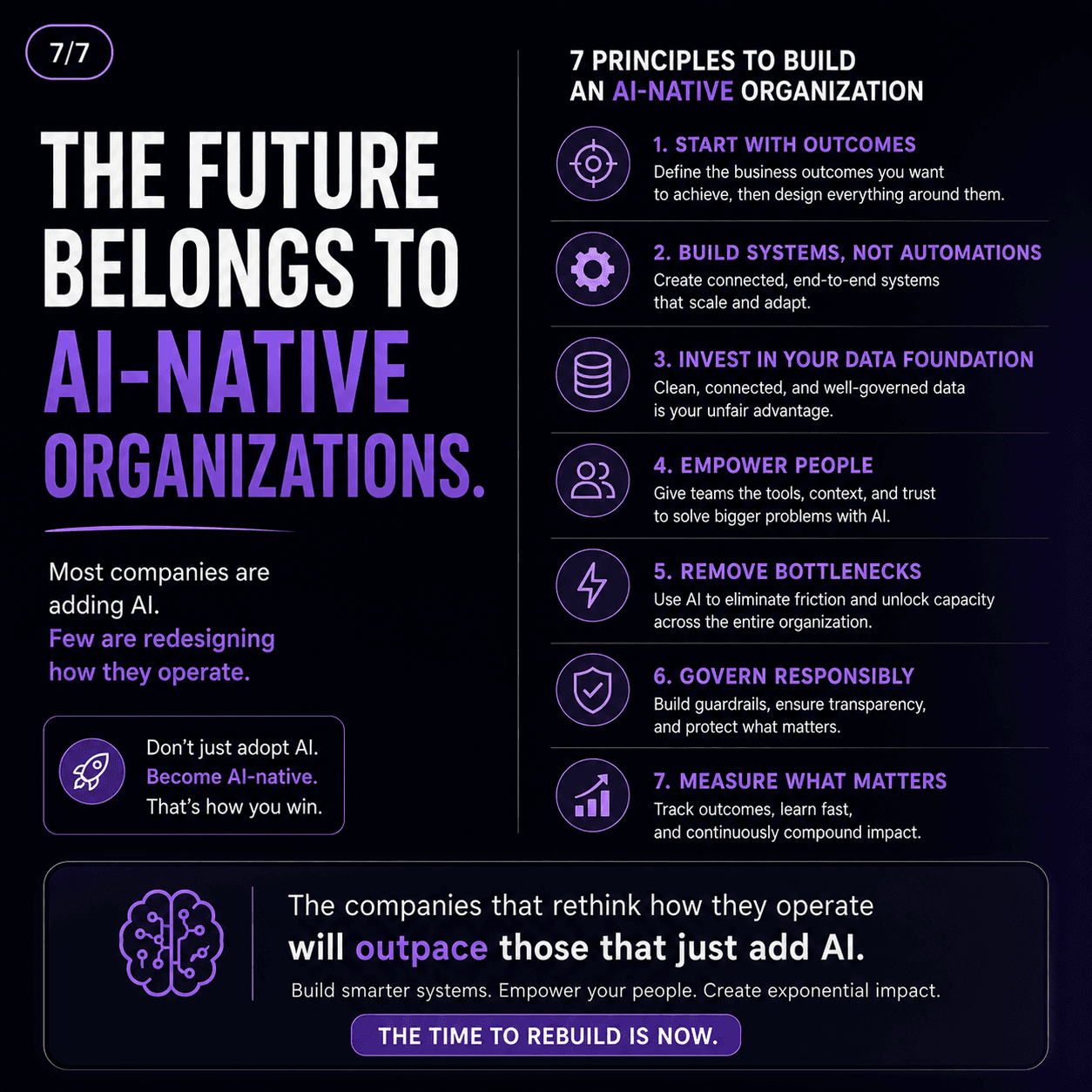
7. Seven principles for an AI-native organization
The future belongs to AI-native organizations. Most companies adopt AI; few rebuild how they work. Here are the seven principles we use with clients and on our own stack:
- Start with outcomes, Define business results first; design everything around them.
- Build systems, not automations, Connected, end-to-end workflows that scale and adapt.
- Invest in your data foundation, Clean, connected, governed data is the unfair advantage.
- Empower people, Tools, context, and trust so teams solve bigger problems with AI.
- Remove bottlenecks, Use AI to eliminate friction and unlock capacity org-wide.
- Govern responsibly, Guardrails, transparency, and protection for what matters (policy and audit).
- Measure what matters, Track outcomes, learn fast, compound impact (Pulse and proof).
The companies that rethink how they operate will outpace those that just add AI. Build smarter systems. Empower your people. Create exponential impact. The time to rebuild is now.
See where AI moves your business, in 3 minutes
Our readiness assessment maps every department, ranks automatable roles for your business, and outlines a 90-day roadmap. No sales call required to get your score.
Related reading
Tags: #ArtificialIntelligence #AI #Automation #BusinessStrategy #FutureOfWork, share the carousel on LinkedIn and link back to this article for the full framework.