When AI and Quantum Computers Merge, Your Security Model Breaks First
Quantum-powered AI could unlock a new era of discovery, faster drug development, sharper climate models, stronger batteries, smarter supply chains. The upside is massive. But the same quantum leap that accelerates science also quietly breaks the cryptography that protects banking, identity, messages, and cloud storage. The dangerous part is that the attack has already started.
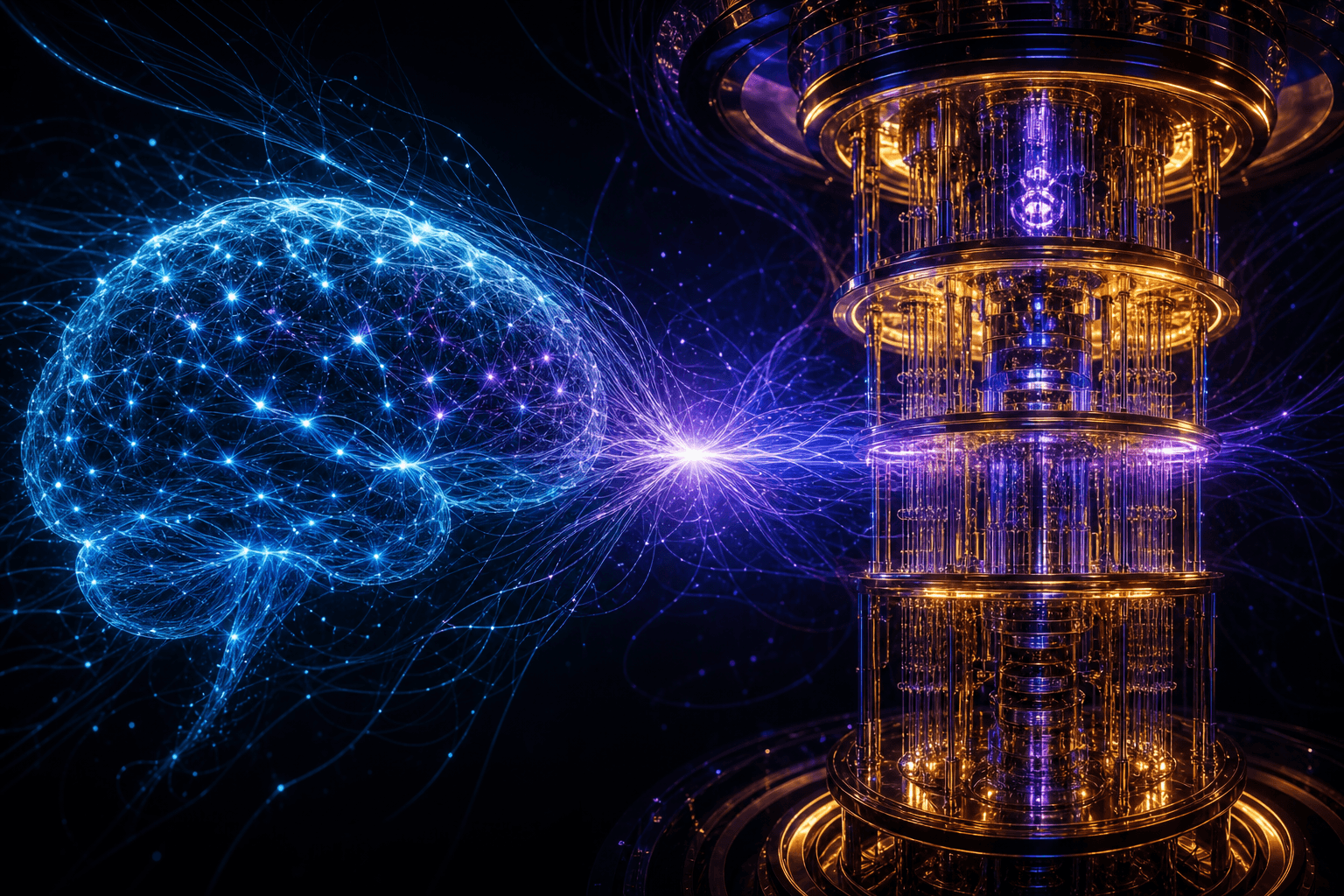
Two technologies are racing toward the same future. AI learns from the world’s data; quantum computing can attack problems too complex for today’s machines. Where they meet, computing gets a step-change, and so does the threat model. Conceptual illustration by Expert AI Labs.
Two technologies are racing toward the same future. Artificial intelligence is learning from the world’s data at a pace that keeps surprising the people who build it. Quantum computing is learning to attack problems that are simply too large for classical machines, simulating molecules, optimizing enormous systems, searching spaces that would take a supercomputer longer than the age of the universe to brute-force.
Put them together and you get something genuinely new. Quantum-powered AI could compress years of research into months: new materials, new medicines, new physics, deeper financial simulations, better models of the world. That is the promise, and it is not science fiction. It is a roadmap that the largest technology companies and national labs are actively funding.
But here is the part that does not fit on a keynote slide. The exact same mathematical leap that makes quantum computing so powerful for science also makes it a wrecking ball for the cryptography that holds modern life together. And because of a specific, under-appreciated attack pattern, the risk does not begin the day a quantum computer goes online. It begins today. This is a field guide to why, written for the founders, engineers, and operators who will have to do something about it.
The one-paragraph version
Almost everything you trust online, banking, payments, identity, messaging, software updates, cloud storage, is protected by public-key cryptography (RSA and elliptic curves). A large, fault-tolerant quantum computer running Shor’s algorithm can break that math. It does not exist yet. But attackers can capture encrypted data now and decrypt it later, so any secret with a long shelf life is already exposed. The fix is post-quantum cryptography, the new NIST standards (ML-KEM, ML-DSA, SLH-DSA), deployed through an architecture that lets you swap algorithms without rebuilding everything. That property is called crypto-agility, and it is the real deliverable.
1. What Quantum-Powered AI Actually Unlocks
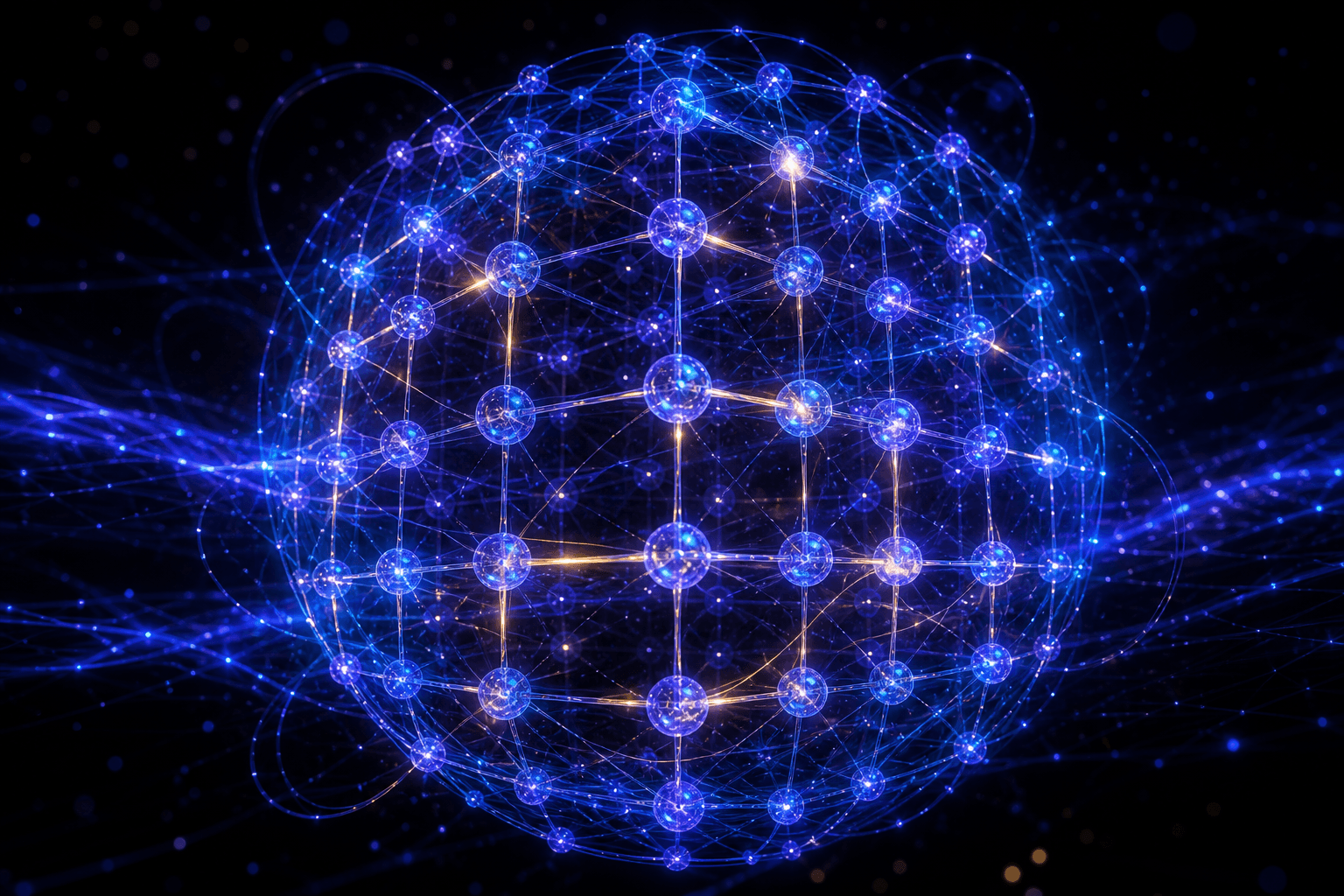
A classical bit is a 0 or a 1. A qubit can hold a superposition of both, and entangled qubits explore an exponentially large state space at once. That is the source of quantum’s power, and the source of the threat. Conceptual illustration by Expert AI Labs.
A classical computer stores information in bits that are either 0 or 1. A quantum computer uses qubits, which can exist in a superposition of 0 and 1 at the same time, and which can be entangled so that the state of one is bound to the state of another. With n qubits you can represent 2n states simultaneously. Thirty qubits is roughly a billion states; three hundred qubits is more states than there are atoms in the observable universe. Quantum algorithms work by orchestrating interference across that state space so the right answers reinforce and the wrong ones cancel out.
For AI and science, that matters in a few specific domains. Quantum systems are naturally good at simulating quantum chemistry, the behavior of electrons in molecules, which classical computers approximate poorly and expensively. That maps directly onto faster drug discovery, better catalysts, and stronger battery chemistries. They are good at certain optimization and sampling problems that show up in logistics, portfolio construction, and the training and inference of some machine-learning models.
The honest caveat, the one most hype skips, is that quantum computers are not faster at everything. They are faster at a narrow but extraordinarily valuable set of problems. Two of those problems happen to be factoring large integers and computing discrete logarithms. Those are not exotic edge cases. They are the exact problems the entire internet’s security depends on being hard.
2. Modern Life Runs on Cryptography You Never See
Before we talk about what breaks, it is worth being precise about what is actually protecting you right now. Every time you see a padlock in your browser, log into a bank, send an encrypted message, install a software update, or move funds in a crypto wallet, you are relying on two kinds of cryptography working together.
Public-key (asymmetric)
RSA, Diffie-Hellman, and elliptic-curve cryptography (ECC). Used to establish a shared secret over an open channel and to sign things, the TLS handshake, code signing, certificates, SSH, VPNs, blockchain signatures. This is what quantum breaks.
Symmetric
AES, ChaCha20, and hash functions like SHA-256. Used to encrypt the actual bulk data once a shared key exists. This survives quantum, with a caveat: double the key size (AES-128 → AES-256) and you are fine.
The pattern almost everywhere is a hybrid: public-key cryptography negotiates a session key, then symmetric encryption protects the data. The weak link in the quantum era is the first half. If an attacker can break the public-key step, they can recover the session key, and then the strong symmetric encryption protecting your data no longer matters, because they now hold the key to it.
3. Why Quantum Breaks It: Shor’s Algorithm and Grover’s Algorithm
Two quantum algorithms matter for security, and they do very different amounts of damage.
Shor’s algorithm (1994) is the catastrophic one. It factors large integers and computes discrete logarithms in polynomial time instead of the exponential time a classical computer needs. RSA’s security rests entirely on factoring being hard; ECC’s rests on the elliptic-curve discrete-log problem being hard. Shor’s algorithm makes both tractable on a large enough quantum computer. This is not a speed-up you can outrun by picking a bigger key, doubling an RSA key size barely moves the quantum cost. It is a structural break.
Grover’s algorithm (1996) is the survivable one. It searches an unstructured space of N items in roughly √N steps, a quadratic speed-up. Applied to symmetric encryption, it effectively halves the key strength: AES-128 drops to about 64 bits of quantum security, which is uncomfortable, while AES-256 drops to about 128 bits, which is still far out of reach. The defense is simple and well understood: use AES-256 and SHA-384/512, and symmetric cryptography remains safe.
The qubit gap, and why estimates keep shrinking
Breaking RSA-2048 with Shor’s algorithm requires a fault-tolerant quantum computer with thousands of stable logical qubits, which in turn requires millions of noisy physical qubits for error correction. Today’s machines have on the order of hundreds to low thousands of noisy qubits. So the threat is not tomorrow.
But the resource estimates have been falling, not rising. A widely cited 2019 estimate put the cost near 20 million physical qubits; revised 2025 analyses brought it under a million by improving the algorithm and error correction. The lesson is not “panic,” it is that the timeline is uncertain and trending toward sooner, and you do not get to choose when an adversary captures your data.
4. Harvest Now, Decrypt Later: The Attack That Has Already Begun
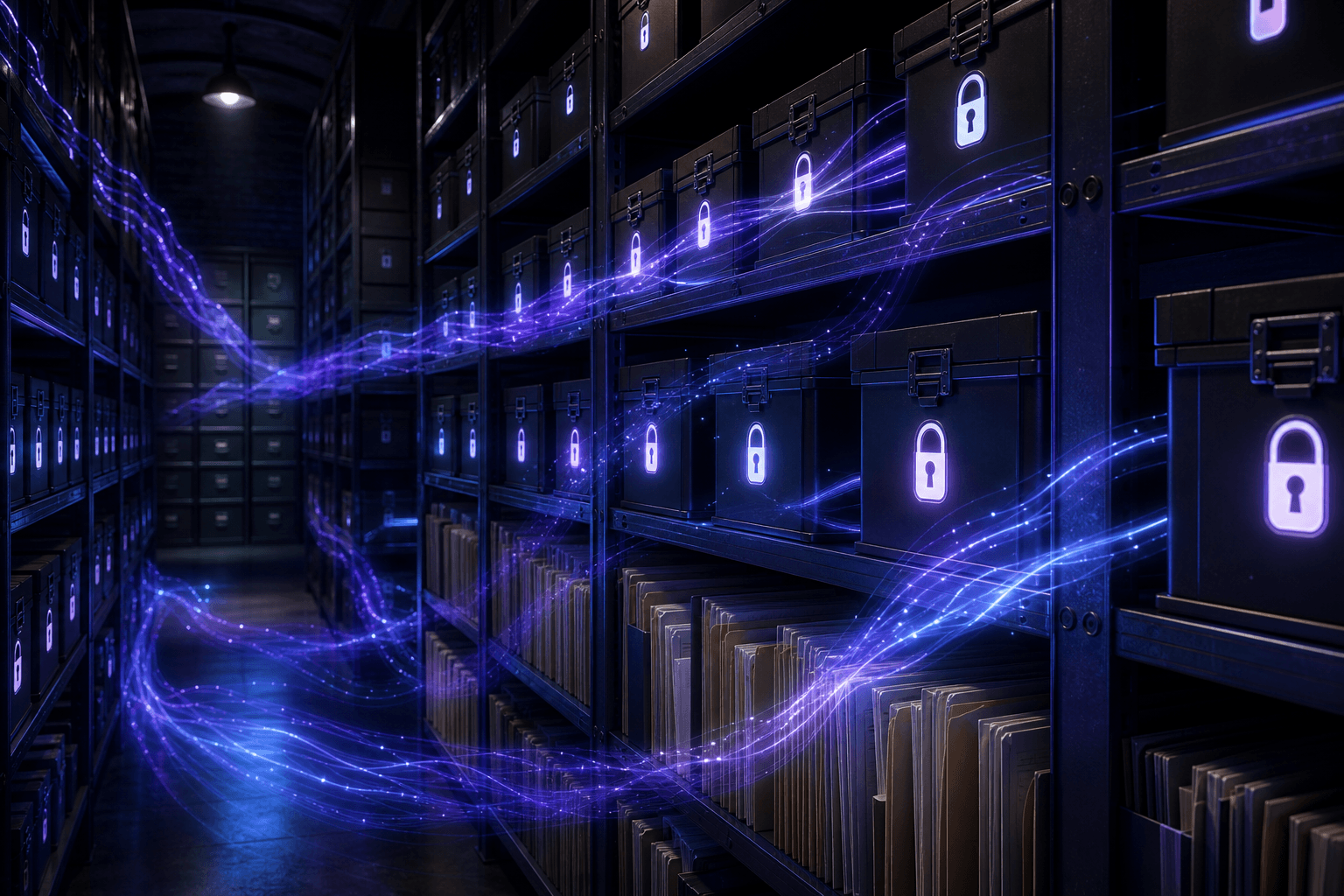
The risk starts before quantum arrives. Encrypted data can be copied today, stored for years, and unlocked later. Medical records, financial data, private messages, identity information, anything with a long secrecy lifetime is already a target. Conceptual illustration by Expert AI Labs.
Here is the idea that should change how you think about the timeline. An attacker does not need a quantum computer today to benefit from one tomorrow. They can intercept and store your encrypted traffic now, sit on it, and decrypt it later, the moment a cryptographically relevant quantum computer becomes available. Security researchers call this harvest now, decrypt later (HNDL), or store now, decrypt later.
For data with a short lifetime, this barely matters, a one-time password is worthless next year. But a huge amount of data has a long confidentiality lifetime, and that is where the exposure lives:
The practical math is uncomfortable: take the number of years your data must stay secret, add the years it will take you to migrate to quantum-safe cryptography, and if that sum reaches the arrival of capable quantum computers, you are already too late. Security researcher Michele Mosca framed this as a simple inequality, and it is the single best argument for starting now instead of waiting for a machine to make the news.
5. Post-Quantum Cryptography: The New Standards Are Already Here
The good news is that the defense is not theoretical and it is not waiting on quantum hardware. Post-quantum cryptography (PQC) refers to algorithms that run on today’s ordinary computers but are built on math believed to be hard for both classical and quantum machines, primarily structured lattice problems and hash-based constructions. After an eight-year global competition, the U.S. National Institute of Standards and Technology (NIST) finalized the first standards in August 2024.
FIPS 203, ML-KEM
Module-Lattice Key Encapsulation (formerly CRYSTALS-Kyber). Replaces RSA/ECC key exchange, this is how two parties agree on a session key. The workhorse of the migration.
FIPS 204, ML-DSA
Module-Lattice Digital Signature (formerly CRYSTALS-Dilithium). The general-purpose replacement for RSA/ECDSA signatures, certificates, code signing, document signing.
FIPS 205, SLH-DSA
Stateless Hash-Based Digital Signature (formerly SPHINCS+). Slower and larger, but rests only on the security of hash functions, a conservative backup that does not depend on the lattice assumption.
A fourth standard for a compact lattice signature scheme (FN-DSA, based on FALCON) is on the way, and NIST is deliberately keeping a diverse portfolio so that if one mathematical family is weakened, others remain. That diversity is a feature: the worst outcome would be betting everything on a single algorithm and discovering a flaw after deployment.
The current best practice for the transition is hybrid key exchange, combining a battle-tested classical algorithm (like X25519) with ML-KEM, so a session is safe as long as either one holds. Major browsers, cloud providers, and messaging apps have already shipped hybrid post-quantum key exchange in production. The standards are not the bottleneck anymore. Deployment is.
6. Security Has to Run on Real Chips, Devices, and Infrastructure
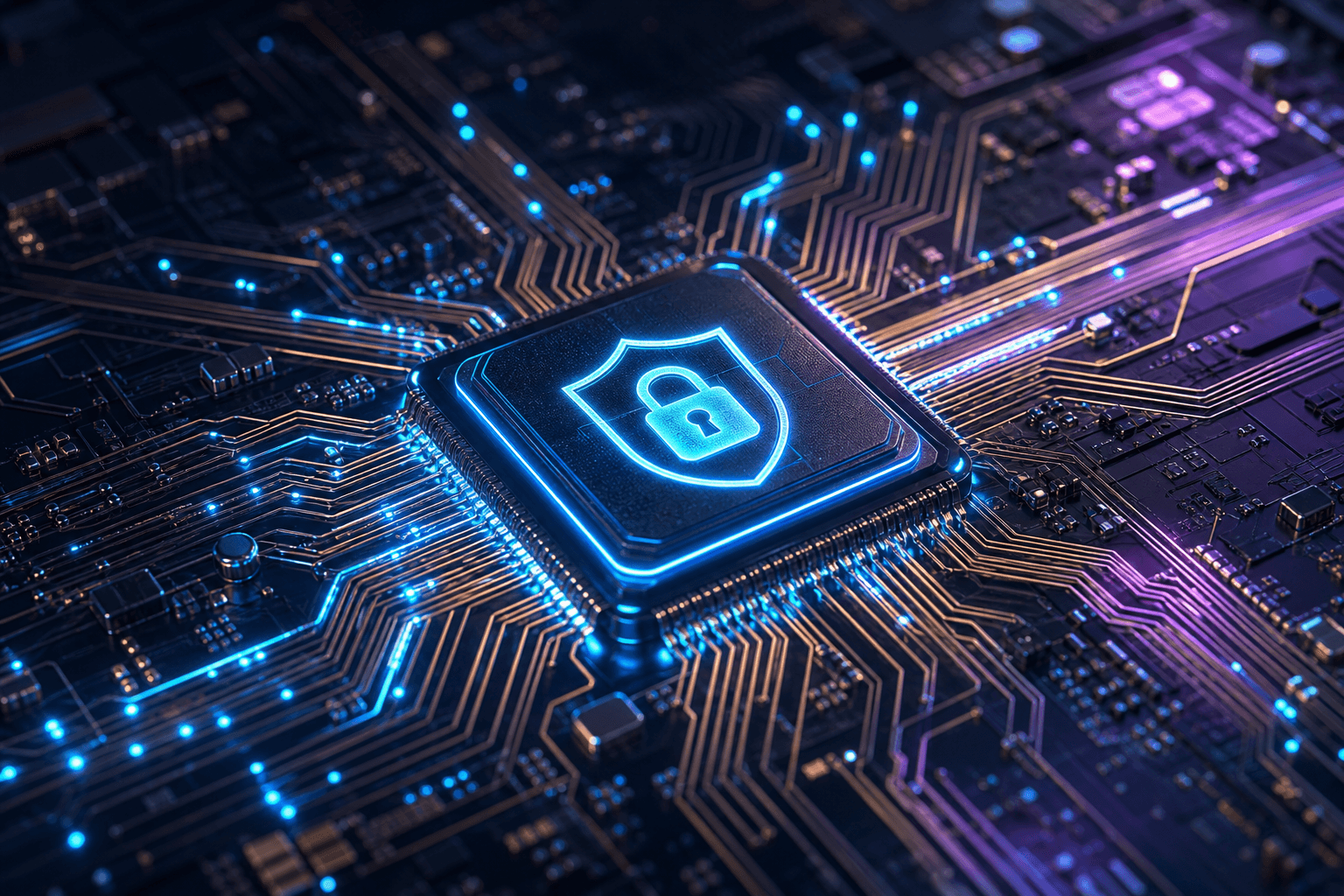
Post-quantum algorithms have larger keys and heavier math than the cryptography they replace. To deploy everywhere, from phones to payment terminals to servers, that math has to be fast and efficient on real silicon. Conceptual illustration by Expert AI Labs.
There is a reason the hardware companies are in this conversation, not just the standards bodies. Post-quantum algorithms are not free. ML-KEM and ML-DSA have larger keys, larger signatures, and heavier arithmetic than the RSA and ECC they replace. An ECDSA signature is around 64 bytes; an ML-DSA signature is a few kilobytes. That overhead is trivial on a laptop and very much not trivial on a constrained device, a smartcard, a car’s electronic control unit, an IoT sensor, a payment terminal, or a server doing millions of TLS handshakes per second.
This is why a wave of work, from companies like BTQ Technologies (Nasdaq: BTQ) and its quantum-secure hardware initiatives, to the cryptographic accelerators being added to mainstream CPUs and secure elements, is focused on making post-quantum cryptography fast and efficient enough to deploy everywhere. Security that is too slow to use gets turned off, and security that is turned off is not security. The migration is not only a software project; it touches firmware, secure enclaves, hardware security modules, and the physical infrastructure that the digital economy runs on.
The takeaway for most businesses is not that you need to design chips. It is that quantum readiness is a full-stack problem, and the vendors you depend on, your cloud, your devices, your payment processors, your identity providers, are part of your migration whether you manage it or not.
7. The Real Deliverable Is Crypto-Agility
Here is the strategic insight that separates teams who will sail through this from teams who will scramble. The goal is not “swap RSA for ML-KEM” one time. The standards will keep evolving, an algorithm may be weakened, regulators will move the goalposts. The goal is crypto-agility: building systems where the cryptographic algorithm is a configurable, swappable component, not a hardcoded assumption baked into a thousand places.
Crypto-agility is the same discipline that good engineering teams already apply to dependencies, secrets, and infrastructure: assume change, isolate the thing that changes, and make swapping it a routine operation rather than a heroic one. Build that once and the post-quantum migration becomes a controlled rollout instead of a fire drill, and the next migration becomes nearly free.
8. A Practical Migration Roadmap
You do not migrate to post-quantum cryptography in a sprint. You do it in stages, and the early stages are about visibility, not algorithms. Here is the sequence that works.
Inventory your cryptography (CBOM)
You cannot protect what you cannot see. Build a cryptographic bill of materials: where keys, certificates, protocols, and libraries are used, what algorithms they rely on, and what data they protect. For most organizations this is the single biggest and most revealing step.
Classify data by confidentiality lifetime
Apply Mosca's inequality. Which data must stay secret for ten or twenty years? That data is exposed to harvest-now-decrypt-later today and goes to the front of the line. Short-lived data can wait.
Establish crypto-agility
Refactor so cryptography sits behind interfaces and is driven by configuration. This is the investment that makes every later step cheap. Do it before, not during, the algorithm swap.
Pilot hybrid key exchange
Turn on hybrid (classical + ML-KEM) key exchange on a non-critical service. Measure the latency and payload impact, validate interoperability, and build operational muscle before touching the crown jewels.
Prioritize signatures and long-lived roots
Code signing, firmware signing, and root certificates have long lifespans and are hard to rotate. Plan ML-DSA / SLH-DSA adoption for these deliberately, they are not where you improvise.
Pressure-test your vendors
Your cloud, identity provider, payment processor, and device makers own large parts of your attack surface. Ask for their PQC roadmaps in writing and align your timeline to theirs.
Monitor continuously
Treat the migration as a living program. New standards, new guidance (CNSA 2.0 targets 2030–2033 for national security systems), and new weaknesses will land. Crypto-agility plus monitoring keeps you ahead of all of them.
9. Where AI Sits in All of This, on Both Sides
It would be a mistake to treat AI as a bystander in the quantum security story. It is an active participant on both sides of the line.
On offense, machine learning makes harvest-now-decrypt-later dramatically more efficient. Adversaries do not store everything, they store what is worth decrypting. AI helps them scan, classify, and prioritize intercepted traffic, fingerprint high-value targets, and surface cryptographic misconfigurations and weak implementations at a scale no human team could match. The data quantum-powered AI will eventually be able to read is also the data AI is helping decide is worth keeping.
On defense, AI is genuinely the only practical way to run this migration at scale. Modern environments are too large and too dynamic to inventory cryptography by hand. AI-assisted discovery can map where cryptography lives, flag deprecated algorithms, watch for anomalous access to long-lived sensitive data (the early signal of a harvesting operation), and track thousands of certificates and libraries through a multi-year transition. The same control-plane discipline that lets a small team operate a large automated business, observability, audit logs, anomaly detection, kill switches, is exactly what a credible post-quantum program needs.
10. What This Means for Your Business
If you run a business that touches money, identity, health, communications, or intellectual property, and almost every business does, the quantum transition is not an abstract physics story. It is a multi-year security program that rewards the organizations that start early and quietly punishes the ones that wait for a headline.
You do not need to predict the exact year a quantum computer breaks RSA. You need to accept that you cannot predict it, that adversaries are already harvesting, and that the work, inventory, classification, crypto-agility, hybrid pilots, vendor alignment, is valuable on day one regardless of when quantum arrives. As the carousel that inspired this piece put it: the future of AI and quantum will only ever be as powerful as the security layer protecting it. Build that layer before you need it.
Final takeaway
Quantum-powered AI could unlock the future. Quantum-aware security decides whether we can trust it. AI keeps getting smarter; quantum systems keep getting stronger; and somewhere in that curve, the cryptography the modern world quietly depends on stops working. The transition has a name, post-quantum cryptography, it has finished standards, ML-KEM, ML-DSA, SLH-DSA, and it has a clear first move: see where your cryptography lives and make it swappable.
The companies that come through this well will not be the ones that guessed the date right. They will be the ones that built crypto-agility into their systems before the date mattered, the same way the resilient companies built secure architecture before the breach instead of after. Start the inventory. Classify the data. Make the algorithm a setting, not a wall.
Frequently Asked Questions
What is post-quantum cryptography (PQC)?
Post-quantum cryptography is a set of encryption and digital-signature algorithms designed to stay secure against large quantum computers. They run on ordinary hardware but are built on math, mainly structured lattices and hash functions, believed to be hard for both classical and quantum machines. In August 2024 NIST finalized ML-KEM (FIPS 203) for key exchange, ML-DSA (FIPS 204) for signatures, and SLH-DSA (FIPS 205) as a hash-based signature backup.
What is a 'harvest now, decrypt later' attack?
It is when an adversary captures encrypted data today, even though they cannot read it yet, and stores it to decrypt later once quantum computers are capable. It matters now because data with a long confidentiality lifetime, medical records, financial data, identity information, trade secrets, is still valuable years from now. Anything intercepted today that must stay secret past the arrival of capable quantum computers is already at risk.
Will quantum computers break RSA and Bitcoin?
A large, fault-tolerant quantum computer running Shor's algorithm could break RSA, Diffie-Hellman, and elliptic-curve cryptography, the basis of TLS, VPNs, code signing, and cryptocurrency signatures. That machine does not exist yet and resource estimates vary, but standards bodies (NIST) and the NSA's CNSA 2.0 are pushing migration well before 2035. Symmetric ciphers like AES are far safer: Grover's algorithm only halves their strength, so AES-256 stays secure.
When should a business start migrating to post-quantum cryptography?
Now, in planning terms, because the migration is multi-year. Start by inventorying where cryptography lives (a cryptographic bill of materials), classify data by how long it must stay secret, adopt crypto-agility so algorithms can be swapped without re-architecting, and pilot hybrid key exchange that pairs a classical algorithm with ML-KEM. CNSA 2.0 targets broad post-quantum adoption for national security systems by 2030–2033, and commercial regulators are expected to follow.
How does AI change the quantum security timeline?
AI accelerates both sides. On offense, it helps adversaries scan, classify, and prioritize the encrypted data worth harvesting and find cryptographic weaknesses at scale. On defense, it is the only practical way to inventory cryptography across large systems, detect anomalous access to sensitive data, and manage a migration spanning thousands of certificates and libraries. Quantum-powered AI also raises the value of the data being protected, which is exactly why the security layer must evolve before quantum scales.
Build AI systems that are ready for what comes next, not just what ships today.
Every Expert AI Labs engagement is built with the operational discipline this transition demands, a cryptographic and data inventory, segmented access, audit logs, anomaly detection, and architecture designed for change instead of frozen around today’s assumptions. We build systems that survive contact with the future.
Related reading
What HBO’s Silicon Valley Can Teach Us About Real-World Cybersecurity
Twelve real threats hiding behind the Pied Piper jokes.
Vibe Coding Can Build the Demo. Production Engineering Builds the Business.
Auth, tenant isolation, audit logs, and the stack that survives.
Meet Your AI Workforce: The 6 Roles That Run Autonomously 24/7
The control plane that makes monitoring at scale possible.