Vibe Coding Can Build the Demo.Production Engineering Builds the Business.
AI coding tools have changed software forever, but software can now look finished long before it is secure, reliable, scalable, or ready for real customers. That is the gap most businesses are underestimating.
A founder can open Cursor, Claude, Lovable, v0, Bolt, Replit, or ChatGPT and build a clean-looking application faster than many teams could scope the project a few years ago. The screen looks polished. The buttons work. The dashboard loads. The MVP feels real.
That is powerful. It also creates a dangerous illusion: software that looks finished long before it is secure, reliable, scalable, or ready for real customers.
Vibe coding can help you build the demo. Production engineering is what turns that demo into a real business system.
The new reality: AI has made software easier to start
There is no denying it: AI has massively lowered the barrier to building software. A nontechnical founder can describe an idea and get a working interface. A startup team can move from concept to MVP in days instead of months. A developer can move faster than ever with AI handling boilerplate, layout, API scaffolding, and repetitive implementation work.
For early-stage ideas, vibe coding is genuinely useful, landing pages, dashboards, internal tools, prototypes, simple apps, and proof-of-concept products. But acceleration is not the same as readiness.

The trap: “it works” does not mean “it’s ready”
The biggest mistake businesses make with AI-generated software is confusing a working demo with a production-ready system. A demo only has to work under controlled conditions. A production system has to work when real users, real data, real payments, real workflows, real employees, real clients, and real business consequences are involved.
- A login page is not the same as a permission system.
- A database table is not the same as a secure data model.
- An API route that works once is not the same as a protected backend service.
- A dashboard that displays numbers is not the same as a reliable reporting system.
- An AI automation that runs once is not the same as a monitored, recoverable workflow.
- A nice interface is not the same as a real product.
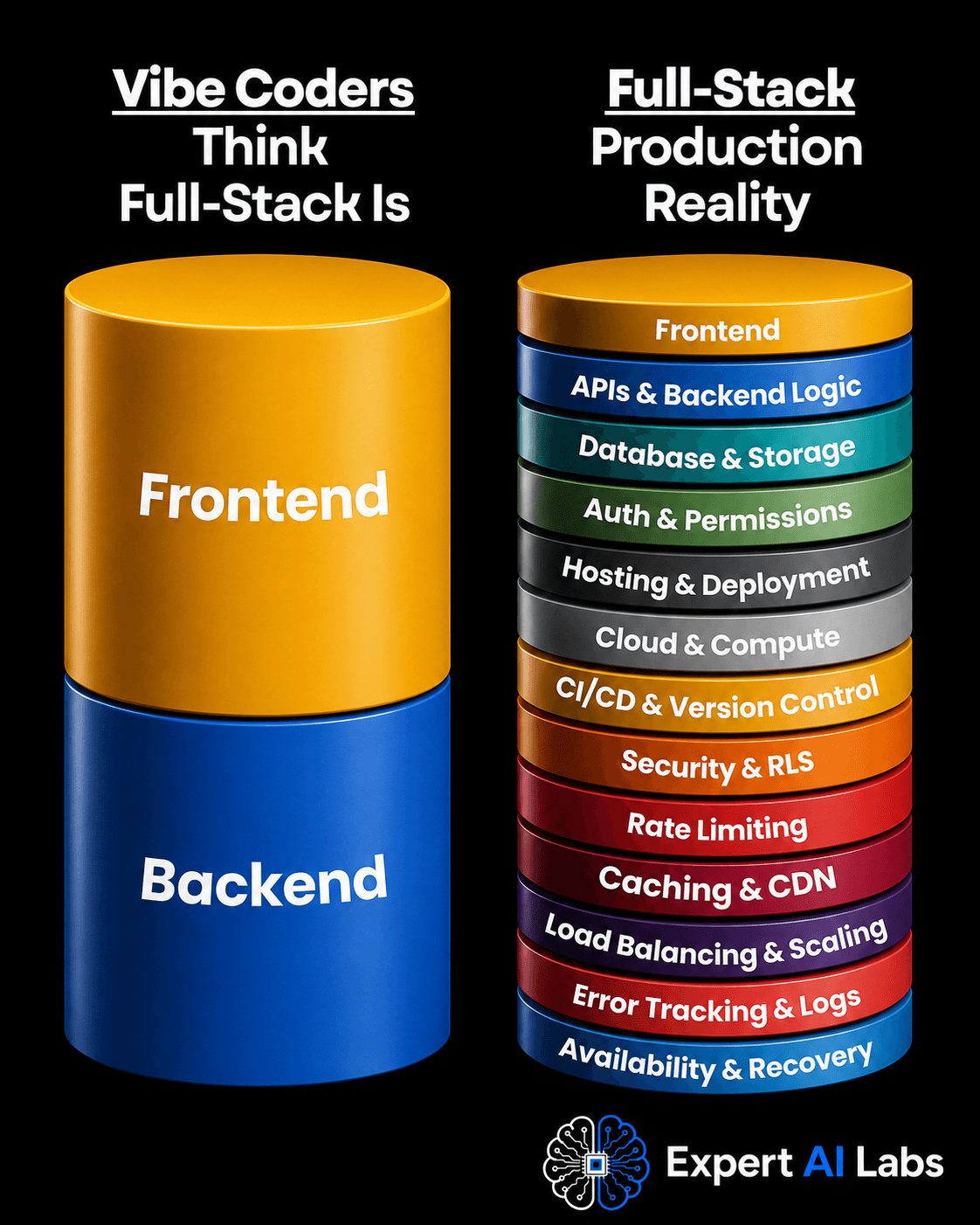
The hidden stack behind real software
Most people think of software as frontend and backend. Real production software has many more layers, and they are where the product actually lives.

What vibe coding usually gets right
Vibe coding is not the enemy. AI tools are excellent for layouts, components, API handlers, database schemas, authentication flows, and initial feature logic. The problem is not that vibe coding is useless, it is that it can make a product feel complete before the hard parts have been solved. And in software, the hard parts usually do not show up in the first screenshot.
What vibe coding usually misses
The dangerous parts of software are often invisible, until something breaks, leaks, or burns budget.
1
Real authentication and authorization
Sign-in is not a permission model. Production needs role-based rules for who can view, create, update, approve, delete, export, and trigger actions, including what AI agents may do autonomously.
2
Multi-tenant data isolation
Hiding data in the UI is not isolation. Postgres and Supabase systems need tenant scoping and row-level security so Company A cannot access Company B, ever.
3
Secure API routes
Every route must answer: authenticated? authorized? valid input? rate-limited? logged? What happens on failure? A dev-only success path is not a production API.
4
Rate limits and cost controls
For AI products, unbounded public endpoints are a financial incident waiting to happen. Usage limits, abuse protection, and per-workflow cost tracking are mandatory.
5
Logging and error tracking
Without structured logs and workflow history, teams guess when automations fail silently for three days. Production systems need memory.
6
Audit trails
Who did what, when, with what data, user, system, or AI? As autonomy increases, accountability becomes a business requirement, not an enterprise nice-to-have.
7
Recovery and failure handling
APIs fail, webhooks arrive late, credentials expire, jobs retry twice. Production engineering plans for failure instead of pretending it will not happen.

Why this matters even more for AI systems
Traditional software follows deterministic rules. AI systems generate outputs, interpret text, trigger workflows, and may act without a human watching every step. That creates operational risk: wrong messages, silent failures, runaway spend, inconsistent outputs, and compliance exposure.
A serious AI system needs human-in-the-loop approvals, role-based permissions, usage limits, cost tracking, audit logs, error monitoring, integration health checks, escalation paths, safe fallbacks, and kill switches for risky workflows. Businesses do not just need AI tools, they need AI operations infrastructure.

Prototype vs business system
A prototype asks: Can this be built? A production system asks: Can this be trusted? Can it handle real users? Protect customer data? Recover from failure? Scale? Be monitored? Control costs? Enforce permissions? Survive mistakes? Once software touches real operations, weak architecture becomes expensive, missed leads, failed automations, duplicated emails, exposed data, and avoidable chaos.
Where Expert AI Labs comes in
At Expert AI Labs, we believe AI should not just generate software, it should power reliable business systems. We help companies design, build, automate, secure, monitor, and improve AI-powered systems that are actually useful in production: automation strategy, secure backends, API architecture, approval workflows, audit logging, production hardening, cost-control systems, integration health checks, and AI control panels.
The goal is not simply to build something that looks impressive. The goal is to build systems that help a business operate better.

AI can generate code. Businesses need systems.
A system has structure, rules, monitoring, accountability, recovery, security, and measurable outcomes. It is designed around the business process it supports. That requires strategy, architecture, engineering judgment, security awareness, workflow design, and an understanding of how businesses actually run.
The future belongs to production-ready AI
Vibe coding is not going away, and it should not. But the market is maturing quickly. Soon the question will not be, “Can AI build this?” It will be, “Can we trust this to run our business?” That is where production engineering, and AI strategy, matter.
Final thought
Vibe coding can build the demo. Production architecture builds the business. The difference between a prototype and a company is everything users never see.
If your company is exploring AI automation, building internal tools, launching an AI-powered product, or trying to turn an AI-generated MVP into something real, the next step is not just more code, it is building the foundation that makes the system secure, reliable, measurable, and ready for real-world use.
Turn your AI-built MVP into a production system
We harden demos into secure, multi-tenant, monitored platforms, with the governance layer AI automations require. Book a strategy call to map the gap between what you have and what your business needs to trust.