
Introduction
Artificial intelligence (AI) is transforming how we work, fueling both excitement and anxiety about its impact on jobs and the future of work. From chatbots handling customer service to algorithms automating routine tasks, AI-driven solutions promise big efficiency gains. But with these advances comes a pressing question: will AI lead to widespread workforce disruption or create new opportunities for workers?
A recent study by the Brookings Institution provides fresh insight into this debate. It indicates that while most workers may weather AI-related changes, up to 6.1 million U.S. workers could struggle to adapt after losing a job to AI. In other words, AI's impact on jobs won't be felt equally by everyone. These findings underscore the importance of workforce adaptability and reskilling in the age of AI.
In this article, we'll break down how AI workforce disruption might unfold, which workers are most vulnerable, and what solutions – from upskilling to responsible AI implementation – can help ensure AI and the future of work coexist in a positive way.
AI Job Automation and Workforce Disruption: An Overview
AI is often described as a general-purpose technology that will disrupt the workforce much like past inventions (electricity, computers, etc.) did. The difference now is the speed and breadth of AI's reach. AI systems are not only automating physical tasks in factories, but also performing cognitive tasks – writing emails, analyzing data, even generating software code. This AI job automation has raised concerns in many industries.
For example, an AI can sift through legal documents or medical images faster than humans, potentially reducing the need for some supporting roles in law firms or hospitals. As AI continues to mature (especially with the rise of generative AI like advanced chatbots), more job functions could be handled by machines.
Does this mean millions will suddenly lose their jobs? History suggests that while technology can eliminate certain jobs, it also creates new ones and changes how existing jobs are done. The impact of AI on jobs is likely to be uneven: some occupations will be heavily automated, others will evolve, and new roles (like AI maintenance or ethics specialists) will emerge.
The key for businesses and workers is to understand which jobs are most at risk and how easily displaced workers can transition to new roles. In other words, it's not just about whether AI can do a job, but also about how well people can adapt when it does. This is exactly the angle the Brookings study explored – looking at both AI exposure (the potential for AI to automate a job) and adaptive capacity (the ability of workers to adjust if that job changes or disappears).
AI Exposure vs. Adaptive Capacity: Insights from Research
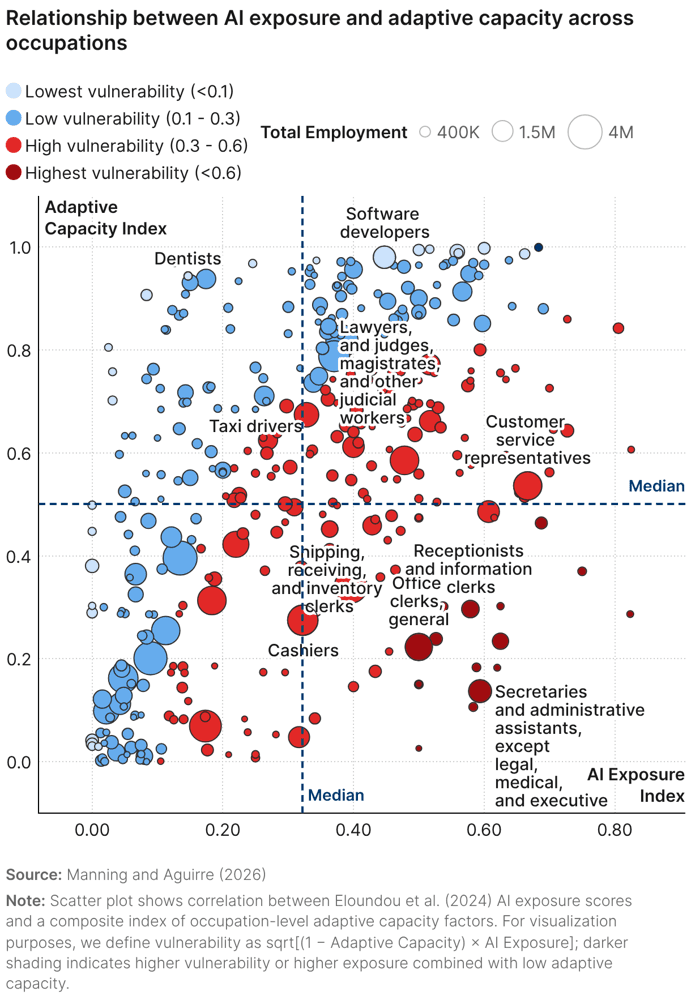
Figure: Relationship between AI exposure and adaptive capacity across U.S. occupations. Each bubble represents an occupation; larger, darker bubbles indicate higher vulnerability (high AI exposure combined with low adaptive capacity). Source: Manning and Aguirre (2026), Brookings Institution.
The Brookings Institution recently conducted an in-depth analysis that maps occupations in terms of their automation exposure and workers' adaptability. The scatter plot above illustrates how jobs with higher AI exposure (further to the right) often require workers to have higher adaptive capacity (toward the top) in order to weather potential disruption.
In fact, the study found a positive correlation between exposure and adaptability: many roles facing significant AI automation are held by workers who are relatively well-equipped to adapt. These tend to be higher-paying professional jobs in tech, finance, and other skilled fields – think of software developers, financial managers, lawyers, and similar professions. Such workers often benefit from strong finances, diverse skills, and deep professional networks, giving them a cushion to adjust or find new opportunities if AI changes their work.
Key Finding: The most exposed workers may also be among the most resilient – a reassuring point often overlooked in doomsday predictions about AI and jobs.
However, the chart also reveals a crucial exception: a cluster of occupations in the lower-right quadrant, where AI exposure is high but adaptive capacity is low. These outlier jobs represent a vulnerable minority of the workforce.
According to the Brookings analysis, of roughly 37.1 million U.S. workers in occupations with very high AI exposure, about 26.5 million have above-average ability to transition (indicating broad resilience) – but about 6.1 million workers (approximately 4.2% of the workforce) are in highly exposed jobs and lack the capacity to easily adapt.
In short, the research concludes there is both broad resilience and concentrated pockets of vulnerability in the face of AI automation. Identifying those vulnerable pockets is critical.
Who Is Most at Risk from AI Disruption?
The workers most vulnerable to AI-related job loss are primarily those in clerical, administrative, and similar support roles. These include many of the routine office jobs that exist across almost all industries – jobs like clerks, secretaries, and assistants that involve a lot of repetitive information processing or straightforward decision-making.
Brookings found that this vulnerable group of ~6 million workers is overwhelmingly female (around 86% women) and is often older, with skill sets tied to specific office tasks. What's more, these workers tend to be concentrated geographically in smaller metropolitan areas, especially college towns and midsized cities in the Mountain West and Midwest.
Why do these particular workers have "low adaptive capacity"? In plain terms, it means they face more hurdles in bouncing back after displacement. Limited savings, fewer transferable skills, older age, and a lack of local job opportunities are key factors that can make it harder for someone to retrain or relocate for a new career.
Brookings researchers warn that without intervention, these workers are "most at risk of lower reemployment rates, longer job searches, and more significant earnings losses" after an AI-related displacement. This is a call to action for policymakers and businesses alike to pay special attention to supporting these vulnerable workers.
The Importance of Adaptability and Reskilling
If there's a silver lining in the AI disruption narrative, it's that adaptability can greatly mitigate the impact. The Brookings study shows that a majority of workers in highly AI-exposed jobs do have the capacity to adapt – thanks to factors like education, transferable skills, and financial buffers. For those who don't, the clear solution is to build that capacity through reskilling and upskilling.
In simple terms, reskilling means learning new skills for a different job, while upskilling means improving skills to stay relevant in the current job as it evolves. Both will be essential in an era of AI.
- Data analysis & interpretation
- AI tool management
- Digital literacy & automation
- Project management software
- Creative thinking
- Complex problem-solving
- Leadership & teamwork
- Emotional intelligence
Organizations like the World Economic Forum emphasize that investment in reskilling and upskilling programs (especially for digital and technical skills) is critical for a future-ready workforce. By improving tech literacy and encouraging lifelong learning, workers can better embrace new technologies rather than be replaced by them.
Support from both government and employers can accelerate reskilling efforts. The Brookings report calls on policymakers to bolster the safety net and training opportunities for displaced workers, suggesting measures like more generous unemployment insurance, longer benefit durations, and "active labor market" policies.
Implementing AI Responsibly: What Businesses Can Do
For employers, adopting AI is not just a technology project – it's a workforce strategy project. How a company introduces AI into its operations can either cause major workforce disruption or usher in a collaborative future where humans and AI thrive together. Responsible AI implementation means anticipating the impact on your people and taking steps to mitigate negative effects.
1. Assess Impact on Jobs and Tasks
Before rolling out a new AI system, conduct an audit of which tasks and roles will be affected. Identify specific job functions that will change so you can plan staff transitions ahead of time.
2. Engage and Communicate with Employees
Involve employees early – explain what the AI does, which parts of their job it might streamline, and how their roles could evolve. Open communication turns a fearful workforce into a collaborative one.
3. Invest in Upskilling and Reskilling Programs
Simultaneously offer training for employees to upgrade their skills through formal courses, online tutorials, or hands-on workshops. Help your workforce move up the value chain.
4. Redesign Jobs for Human-AI Collaboration
Augment your staff with AI – let AI handle repetitive, high-volume tasks while humans focus on creative, strategic, and interpersonal work that AI cannot replicate.
5. Lead with Ethical and Human-Centric Values
Integrate ethics and empathy into your AI strategy. Set guidelines that no AI project will be introduced without considering "people impact." Offer transition assistance to anyone whose role becomes redundant.
In our experience as a software development and AI implementation company, we have found that businesses reap the most benefits from AI when they pair technology deployment with workforce development. Upgrade the systems and the staff on the same schedule, and tell people what is changing before it changes. Most of the fear in these projects comes from not knowing what happens to your own job.
Conclusion & Call to Action
The rapid advancement of AI does indeed herald significant changes for workplaces across the country. Certain jobs will be altered or eliminated, but many workers will also find new roles, aided by adaptability and continuous learning. The research from the Brookings Institution makes it clear that while the alarmist headline of "AI taking all the jobs" is oversimplified, we do have a real challenge to address: there is a segment of the workforce – perhaps around 6 million strong in the U.S. – that is particularly vulnerable and will need extra support to navigate the transition.
As business leaders, policy makers, and communities, our task is to ensure that the age of AI becomes a story of workforce evolution, not just workforce disruption.
At Expert AI Labs, we believe the future of work should be one where humans and AI complement each other to achieve greater productivity and creativity. Achieving that future means being proactive and compassionate today. Start by working out which roles in your own company are affected and how, then decide what retraining you owe those people before the system goes live.
Sources
The analysis and data on AI exposure and adaptive capacity are drawn from a January 2026 Brookings Institution study on AI-driven job displacement by Manning and Aguirre. Additional context on workforce impacts and recommendations comes from Brookings Metro research and insights by the World Economic Forum on reskilling for the future. These studies offer a nuanced look at how AI might reshape labor markets – and how we can respond to ensure a thriving future of work for all.